
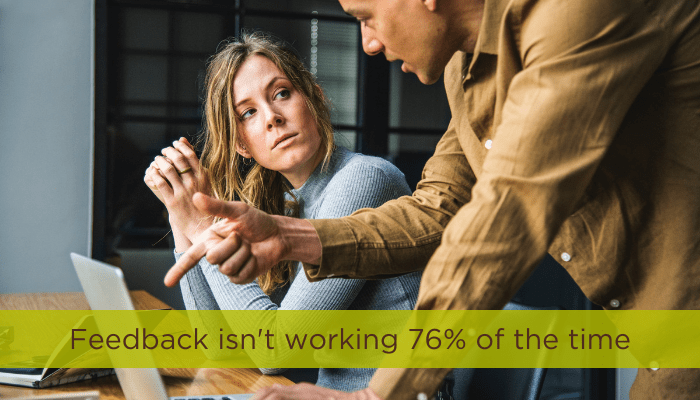
A recent Gallup Workplace article titled Feedback Is Not Enough says that “only 24% of workers strongly agree that the feedback they receive helps them do better work”.
That means that three out of four people do not think the feedback they’re getting is helping them make meaningful change. Not only that, “research shows that it only improves performance one-third of the time, while actually making it worse one-third of the time”.
So clearly it’s time to rethink how you’re giving feedback!
The Definition of Feedback in the Workplace
Changing workplaces
When more companies had a strict top-down structure and clear hierarchy, traditional feedback made a lot more sense. These days, however, teams tend to have a more fluid structure with some members working remotely, so it’s probably time to update the way we interact with each other and learn from past mistakes.
Not only that, but managers are no longer there just to make sure everyone is getting their job done. They now work to harness the creativity of their team, encourage collaboration, and deal with more complex problems.
The Cost of Bad Feedback
Bad feedback doesn’t just land poorly. It creates ripple effects that can tank morale and productivity faster than a surprise Friday afternoon meeting. You’ve probably seen it: a manager drops a vague “you need to be more strategic” with zero follow-up. Or worse, someone finally hears months later that their last presentation “missed the mark,” with no specifics and no shot to fix it.
Here’s what that kind of feedback actually does:
- Kills trust. People stop asking questions, stop sharing ideas, and start watching their backs.
- Slows everything down. When employees are confused or second-guessing themselves, productivity tanks.
- Breeds resentment. Vague or inconsistent feedback makes people feel judged, not supported. That’s how you end up with eye rolls, passive-aggressive emails, and a team that’s quietly checked out.
- Breaks team cohesion. When feedback feels like blame, it drives a wedge between people. You can’t build high-performing teams if folks are playing defense.
- Increases turnover. People don’t leave jobs—they leave bad managers. Or in this case, they leave managers who don’t know how to coach.
You don’t get stronger by lifting with bad form. Same goes for teams. If the feedback is off, the whole system suffers.

Different Types of Feedback: Intention Vs. Perception
The shortcomings of traditional feedback (or what you can learn from dog training)
There are several things that make traditional feedback, done through performance reviews or other scheduled conversations, less effective.
First, it often comes long after the event that you are reacting to since it is often only offered intermittently.
Dog trainers will tell you that there is no sense in punishing a puppy for something unless you catch them in the act. If you yell about your chewed up shoe, but it’s been four hours since they chewed it, they have no idea why you are yelling at them. They won’t know that means don’t chew shoes, they will just learn that you are scary!
People are the same. Hearing about what could have been done differently on a project that was finished a month ago probably isn’t going to lead to any real change in behavior.
In addition to the timing issues, feedback often feels like a one-way street. Employees will feel more engaged in the solutions if they are given the space to help create them. Allowing for feedback to be more of a conversation will give space for everyone’s ideas to be heard. That’s where coaching comes in.
Feedback vs. Coaching: What’s the difference
So if traditional feedback falls flat, what’s the alternative?
It’s not scrapping feedback entirely, it’s evolving it. That’s where coaching comes in. Think of feedback as the treadmill everyone dreads, and coaching as the group fitness class that actually makes you want to show up.
Here’s the core difference: feedback is about evaluation; coaching is about development.
Feedback often sounds like, “Here’s what you did wrong.” Coaching sounds more like, “Where do you think it went off track—and how can we fix it together?”
Feedback tends to be one-directional. Coaching opens up a two-way street. It invites curiosity instead of defensiveness. It builds momentum instead of just pointing out missteps. It transforms a critique into a conversation.
And best of all, it builds trust. When leaders show up as coaches, not just as managers, they create the kind of psychological safety that fuels high-performing teams. It’s less about proving you’re right and more about partnering on what’s possible.
Using coaching to improve performance
There is definitely still room to give feedback and learn from past performance. However, there are a few tricks from coaching that can have a greater impact than feedback alone:
- Ask questions. Traditional feedback tends to be about telling your opinions and observations. Start a conversation instead by asking employees for their thoughts on how things are going, what they think could be different, etc. Asking questions will give them a chance to feel more a part of the process.
- Focus on the future. Instead of only worrying about what happened in the past, talk together about how they can do things differently next time. Partner with them to brainstorm, and encourage employees to contribute their ideas for improvement. This will make them more bought in to implementing change in the future.
- Build relationships. I know this probably sounds like it’s out of left field, but the truth is the stronger your relationships are, the more possible it is to have hard conversations, address issues, and make change from a place of trust and understanding. So put in the effort to learn about your employees, understand how they work best, and build a relationship that is based on trust.
Coaching Questions That Actually Work
Here are some coaching-style questions that build reflection, ownership, and action:
- “What part of that project felt most challenging?”
- “Where do you feel most confident? Least confident?”
- “What would you do differently next time?”
- “What support do you need?”
- “How do you want your teammates to see you?”
- “What’s one thing you want to improve this month?”
- “How do you want to grow in your role?”
These questions aren’t about catching mistakes. They’re about developing leaders. Every one of them builds self-awareness and trust.
Don’t Just Spot Mistakes—Train for Growth
If your feedback isn’t helping people improve, or seems to be making things worse, it’s time to rethink the approach. That doesn’t mean abandoning feedback altogether. It means shifting how and when we give it.
Coaching offers a better path. It focuses on real-time conversations, not post-mortems. It’s less about pointing out what went wrong and more about working together on what could go better next time. It gives employees a voice in the process and builds the kind of trust that makes honest conversations possible.
You still hold people accountable—but in a way that helps them grow, not shut down. And that shift? It’s what turns feedback from a dreaded obligation into a useful tool.
Not softer. Just smarter.
Frequently Asked Questions
What is the difference between coaching and feedback in the workplace?
Coaching focuses on development and future performance, while traditional feedback often focuses on past mistakes. Coaching is collaborative, conversational, and trust-building—key ingredients for high-performing teams.
Why doesn’t traditional workplace feedback work anymore?
Research shows feedback only improves performance one-third of the time—and can make it worse just as often. Outdated structures and delayed delivery make it ineffective in today’s more dynamic, collaborative environments.
How does coaching improve employee performance?
Coaching helps employees reflect, take ownership, and make changes in real time. By asking questions and focusing on the future, it creates space for real growth and strengthens team cohesion.
What are the risks of giving bad feedback at work?
Poor feedback can erode trust, lower productivity, increase turnover, and damage team culture. It often creates confusion and defensiveness instead of clarity and progress.
How can managers use coaching instead of just giving feedback?
Managers can shift by asking open-ended questions, focusing on what’s next rather than what went wrong, and building relationships rooted in trust.
When is feedback still useful in the workplace?
Feedback is still valuable when it’s specific, timely, and part of a larger coaching conversation.


