
Visionary and Integrator conflict isn’t always easy to see, especially if the business is doing well.
The business has traction, the scorecard tells a mostly positive story, rocks are getting done, and meetings are far more productive than they used to be. If someone were to observe your leadership team for an hour, they’d likely conclude that EOS is doing exactly what it promised to do.
And yet, beneath that progress, the relationship between the Visionary and the Integrator often carries more tension than either person expected. Not open conflict, necessarily, but a steady undercurrent of frustration, second-guessing, or emotional fatigue that makes collaboration feel heavier than it should.
This is where many leadership teams quietly wonder if they’re doing something wrong.
They’re not.
In fact, this tension is often a sign that both roles are being fully expressed. This is a good thing… if Visionaries and Integrators are willing to talk about it.
The Obvious Difference (And Why It Doesn’t Fully Explain the Problem)
EOS does a great job of defining the differences between Visionaries and Integrators. Visionaries are future-focused, idea-driven, and comfortable moving quickly with incomplete information, while Integrators are wired to bring order, discipline, and consistency to the organization, translating vision into execution that actually works.
Those differences matter, and they absolutely create friction.
But if style alone were the only issue, most Visionary–Integrator pairs wouldn’t have tensions once EOS was in place. The fact that tension often increases after traction takes hold tells us something else is going on.
What’s really at play are a few core tensions that don’t get talked about nearly enough, even in well-run EOS organizations. These tensions aren’t problems to solve once and move past; they’re ongoing dynamics that need to be acknowledged, discussed, and recalibrated as the business grows.
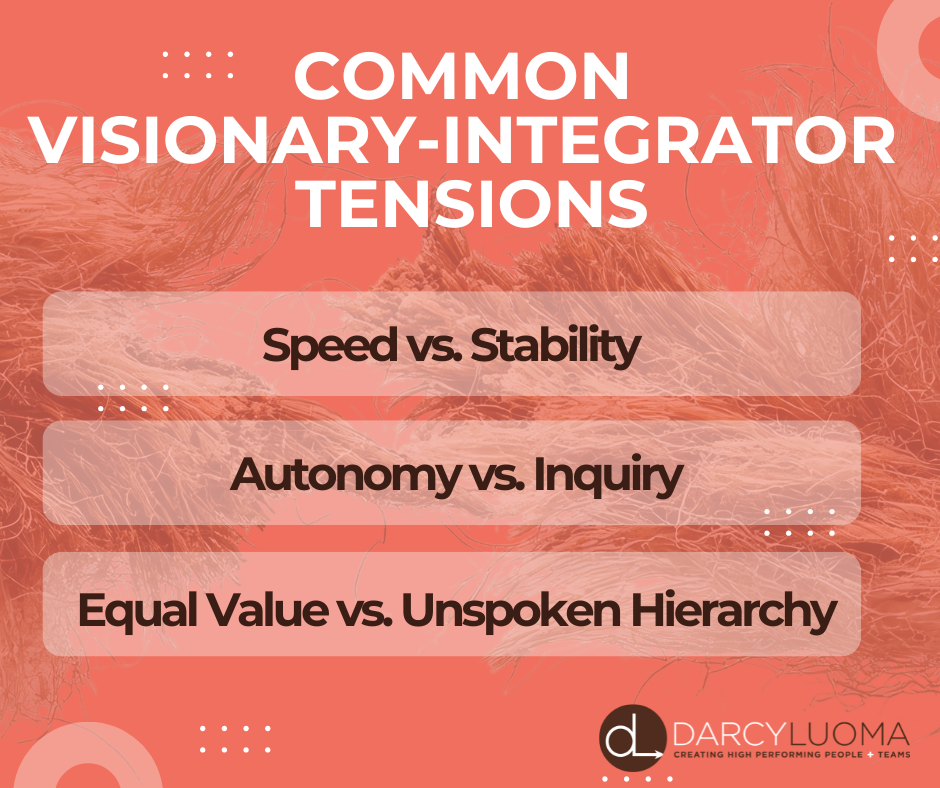
Visionary and Integrator Tension #1: Speed vs. Stability
Optimizing for Different Risks
At the heart of many Visionary–Integrator conflicts is a simple but powerful reality: they are managing fundamentally different risks.
Visionaries are often optimizing for the risk of missing what’s next. They’re scanning the horizon, feeling the urgency of opportunity, and worrying that if the organization moves too slowly, it will lose momentum, relevance, or competitive advantage.
Integrators, on the other hand, are optimizing for the risk of breaking what already works. They’re holding the complexity of the current operation, seeing how changes ripple through systems and people, and worrying that moving too fast will create chaos, rework, or burnout.
Both perspectives are rational. Both are necessary.
The trouble starts when these risk profiles aren’t explicitly named. Instead of recognizing that they’re protecting different outcomes, Visionaries and Integrators often begin to interpret each other’s behavior through a personal lens (seeing caution as resistance or speed as recklessness) when it’s really role-based responsibility showing up exactly as designed.
When this tension goes unspoken, frustration builds not because of disagreement, but because of misunderstanding.
What This Tension Looks Like Day to Day
- The Visionary leaves a meeting thinking, “We’re on our way!” The Integrator leaves the same meeting thinking, “We just created three new problems.”
- The Integrator feels like they’re constantly pumping the brakes. The Visionary feels like they’re constantly trying to move things along.
- Decisions get revisited because one person thought it was a green light and the other thought it was a discussion.
- Ideas keep coming up that feel exciting on the surface but exhausting underneath.
- Both people believe they’re protecting the company. And quietly annoyed at the other for not seeing it.
What the Visionary and Integrator Really Need to Be Talking About
- “When you slow this down, the story I’m telling myself is ______. Is that actually true?”
- “When you push for speed here, what fear is driving that for you?”
- “What are you trying to protect that you don’t think I’m seeing?”
- “What happens for you if we get this wrong?”
- “Where do you feel like you’re carrying risk alone?”
- “What would it look like for us to share ownership of this risk instead of pulling in opposite directions?”
Visionary and Integrator Tension #2: Autonomy vs. Inquiry
“Let Me Execute” vs. “Help Me Understand”
Another common source of friction shows up around how questions are asked, how they’re received, and what they’re assumed to mean.
Integrators need autonomy to do their job well. Execution requires focus, authority, and the freedom to make decisions without feeling constantly second-guessed. When that autonomy is compromised, even unintentionally, it can quickly feel like a lack of trust.
At the same time, Visionaries need space to ask questions. For many Visionaries, asking questions is how they process, connect dots, and stay engaged with the business. It isn’t micromanagement; it’s how their mind works.
The problem isn’t that questions are being asked or boundaries are being set. The problem is how easily intent gets misinterpreted.
A Visionary asks a question, and the Integrator hears doubt.
An Integrator sets a boundary, and the Visionary hears disengagement.
What makes this especially tricky is that there’s no universal right answer. Every Visionary–Integrator pair has to define for themselves what healthy inquiry looks like and where autonomy needs to be protected, and that balance will shift as the organization evolves.
EOS doesn’t dictate that line. The relationship does.
What This Tension Looks Like Day to Day
- The Visionary asks a question and thinks, “I’m just trying to understand.” The Integrator hears it as, “I don’t trust how you’re handling this.”
- The Integrator sets a boundary and thinks, “I need room to do my job.” The Visionary experiences it as being shut out or dismissed.
- The Integrator becomes more guarded or curt in responses. The Visionary starts either pushing harder or pulling back completely.
- Questions start to feel loaded instead of curious.
- Both people adjust their behavior, not because they’re aligned, but because they’re trying to avoid friction or protect their lane.
What the Visionary and Integrator Really Need to Be Talking About
- “Where do you need to feel fully in charge in order to do your best work?”
- “What kind of involvement from me actually makes your job harder?”
- “What do you need from me so my curiosity doesn’t feel like judgment?”
- “When I ask questions like this, what meaning do you attach to it?”
- “What kinds of questions help and what kinds immediately put you on the defensive?”
- “How do we want to handle this when one of us crosses the line we haven’t clearly defined yet?”
Visionary and Integrator Tension #3: Equal Value vs. Unspoken Hierarchy
Leveraging Strengths Without Ranking Them
Even in organizations that genuinely believe in the EOS model, an unspoken hierarchy can quietly take hold.
Sometimes the Visionary is seen by others or by themselves as the “real” leader, while the Integrator is viewed as the one who makes things happen behind the scenes. Other times, the Integrator becomes the steady center of gravity, while the Visionary is tolerated as the source of disruption that has to be managed.
Neither framing is healthy.
When one role is subtly elevated above the other, resentment builds. The person who feels undervalued may disengage or overcompensate, while the person who feels overly constrained may push harder, creating exactly the friction they’re trying to avoid.
EOS works best when both roles are understood as deeply strategic, not when one is treated as visionary and the other as operational in a way that minimizes their contribution. The strength of the partnership isn’t specialization alone; it’s mutual dependence and appreciation.
What This Tension Looks Like Day to Day
- One role’s perspective consistently carries more weight in discussions, even when no one intends it to.
- The Visionary feels like the Integrator is there to “make it happen,” not shape the direction. Or the Integrator feels like the Visionary gets credit for the wins while they absorb the fallout.
- Decisions subtly defer to one person’s opinion, even when accountability technically sits with the other.
- Frustration shows up as disengagement, sarcasm, or quiet compliance rather than open disagreement.
- Both people say they respect each other’s roles and still feel, at times, undervalued or constrained.
What the Visionary and Integrator Really Need to Be Talking About
- “Where do you feel like your contribution gets minimized or taken for granted?”
- “When do you feel most respected by me? And when do you feel not respected?”
- “What parts of your role feel invisible to the rest of the organization?”
- “What do you need from me to feel like a true partner, not a supporting role?”
- “How do we reinforce, out loud and in front of others, that both of our roles are essential to this company’s success?”
Why These Tensions Don’t Show Up on the Scorecard
One of the most challenging aspects of Visionary–Integrator tension is that it rarely shows up in obvious metrics.
The business can be growing. Customers can be happy. Employees can be productive. And still, the leadership relationship can be quietly draining energy, creating friction that everyone feels but few can articulate.
This is often why successful EOS companies feel confused by the tension they’re experiencing. From the outside, everything looks fine, which makes the internal strain harder to name and easier to dismiss. That is, until it starts affecting decision-making, communication, and trust.
What Most Visionaries and Integrators Try (And Why It Backfires)
When this tension becomes uncomfortable, many leadership teams respond by leaning harder into structure. They add more process, clarify more roles, or try to limit interaction to avoid conflict, hoping the system will absorb what the relationship can’t.
Structure is important, and EOS provides it beautifully, but structure can’t replace partnership.
Avoiding the conversation doesn’t make the tension go away; it simply pushes it underground, where it tends to surface later in less productive ways.
What Actually Helps These Tensions Stay Productive
What helps most isn’t another tool or framework, but ongoing, intentional conversation about how these tensions are showing up right now.
That conversation is often easier with someone outside the day-to-day who can slow things down, surface assumptions, and help both the Visionary and the Integrator hear what’s underneath the behavior without turning it into a power struggle or a referendum on competence.
Coaching doesn’t eliminate tension. It helps leadership teams work with it instead of against it.
Traction Is a Starting Point, Not the Finish Line
The Visionary–Integrator relationship is the hinge point for long-term success, and like any critical partnership, it requires attention, dialogue, and recalibration as the business grows.
When those conversations happen consistently and thoughtfully, the tension that once felt exhausting can become a source of strength that fuels better decisions, healthier leadership, and a company that not only grows, but grows well.
Frequently Asked Questions about EOS Visionary and Integrator Conflict
What causes conflict between EOS Visionaries and Integrators?
Conflict usually isn’t about personality. It stems from ongoing tensions between the nature of the roles and is made worse by the avoidance of talking about it. These tensions often intensify as a business grows, making conversations even more important.
Is Visionary and Integrator tension normal in EOS companies?
Yes. Tension is common between strong, successful leaders. In fact, it often increases as the business gains traction and complexity, not because something is broken, but because both roles are fully engaged.
Why does Visionary–Integrator tension increase as companies grow?
Growth adds complexity, raises stakes, and amplifies differences in how risk is managed. As decisions carry more weight, unspoken assumptions between Visionaries and Integrators become harder to ignore.
How can Visionaries and Integrators work through tension productively?
The most effective teams talk openly about the underlying tensions rather than avoiding them. Naming fears, assumptions, and expectations (and revisiting them over time) helps keep the relationship strong and aligned.
When should an EOS leadership team consider coaching?
Coaching can be helpful when tension is draining energy, slowing decisions, or creating recurring frustration that tools and processes alone aren’t resolving. If there’s a desire to figure it out and work better together, coaching can help.
Can we ever fully eliminate Visionary–Integrator tension?
No, and that’s not the goal. The goal is learning how to work with it instead of around it.
Why do we keep having the same argument?
Because the surface issue keeps changing, but the underlying tension hasn’t been addressed.


