

A few weeks ago, someone called us and said, “I’m not a fan of team building, but I need to increase our employee engagement survey scores.”
I have to admit I loved the honesty.
I get it. Say “corporate team building” and you can almost hear the collective groan. People picture forced fun, awkward icebreakers, or an afternoon spent doing an activity that has absolutely nothing to do with the problems waiting for them back at the office.
If that’s your experience with team building, you have good reason to be skeptical. But here’s the problem: Even if you don’t care about team building, your team still needs to work well together. If they don’t, it will eventually affect what you do care about.
My Dad Would Have Hated Team Building
My dad worked as a data processing manager at a manufacturing company back when computers were first being integrated into business. He was a blue-collar guy in a whitish-collar job that was still being defined.
I remember sitting at the dinner table listening to him talk about work. The conversations were rarely about the actual work he was doing. It was usually about his co-workers.
There were coworkers he loved working with, but there were a lot more people who drove him nuts. I remember the first time he had to fire someone and how much it affected him. I watched him wrestle with the people side of being a manager, although that’s not how he described it.
He never talked about “team dynamics.” However, he did talk about the two coworkers whose arguments he constantly mediated and the gossip he was tired of hearing. I knew who in the office he could count on and who was usually calling in the middle of the night when things weren’t going well during third shift.
My dad worked with computers and people. Even as a kid, I knew which of those he preferred.
He wanted to do the work. He didn’t want to get in the middle of other people’s issues. He didn’t want to chase people to get their work done. And he definitely wouldn’t have wanted to sit around talking about any of it.
I’m pretty sure if I had told him then that I would someday make a living helping teams work better together, he would have thought what I do was a little ridiculous.
You Can Ignore Team Dynamics. They’re Still There.
You don’t have to love talking about trust issues, communication patterns, or team dynamics. But when people don’t trust each other, they hold back information. When they can’t work through conflict, problems linger. When nobody wants to call out a missed commitment, the reliable people quietly pick up the slack and slowly get resentful. When employees don’t feel connected to their team, leaving gets a little easier.
Eventually, the “soft skills” get pretty hard.
It can show up in turnover rates. Employee engagement scores. Absenteeism. Missed deadlines. Customer complaints. Productivity. Manager time spent refereeing conflicts that two adults should be able to work through themselves.
You can be skeptical of team building and still choose to make your team better.
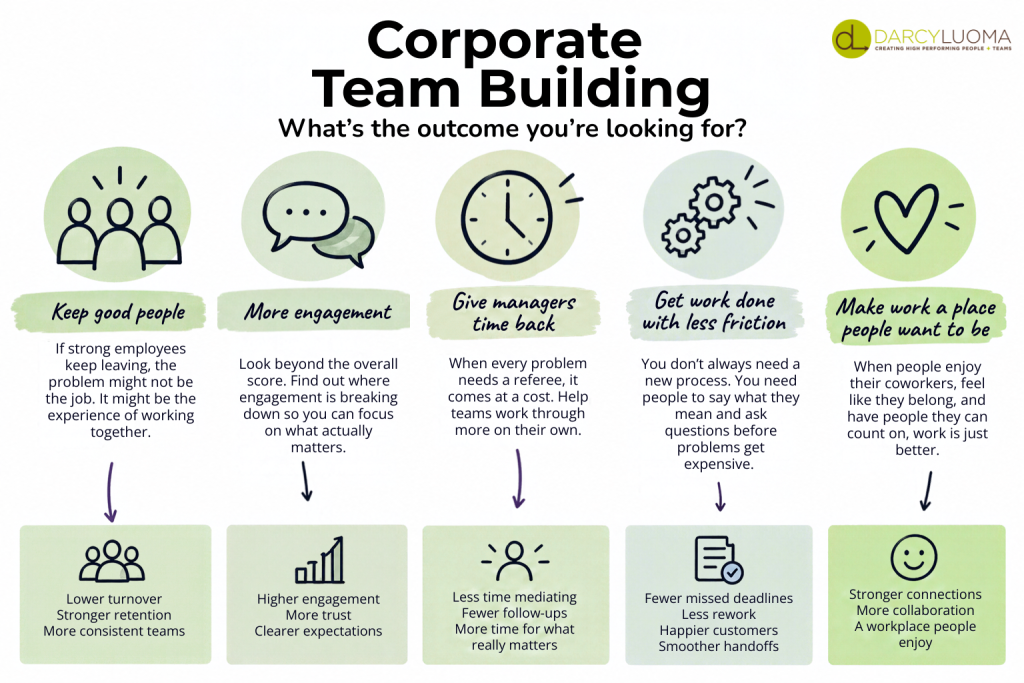
Corporate Team Building Should Make Something Better
“Improve employee engagement” is a goal. So is “reduce turnover” or “build a stronger team.” But none of those tells you what actually needs to change.
The useful work starts one level deeper. What’s contributing to the turnover? Where is engagement breaking down? What is this team struggling to do together?
Once you understand that, corporate team building can have a much clearer target, which is ideally more specific than “we want to work better together.” Here are a few concrete goals that team building can contribute to:
- Keep good people. Look at voluntary turnover, retention, and how long people stay. If one team keeps losing strong employees, pay attention to what it feels like to work on that team. Sometimes the problem isn’t the job. It’s the experience of doing the job with these particular people.
- Move the engagement measures that matter. Don’t just look at the overall score. Where are the low scores? Do employees feel heard? Do they trust their leaders? Do they believe their coworkers are committed to doing good work? Do they know what’s expected of them? The answers tell you what actually needs attention.
- Give managers some of their time back. How much time are managers spending untangling miscommunication, following up on commitments, or mediating issues employees could address with each other? If every problem needs a referee, you don’t just have a relationship problem. You have an expensive use of leadership time.
- Get work done with less friction. Look at missed deadlines, rework, customer complaints, handoff problems, and projects that stall between departments. Sometimes you don’t need a new process. You need people to say what they mean, ask questions sooner, and address problems before they get expensive.
- Make work a place people actually want to be. This one counts too. People spend a huge portion of their lives working. If they enjoy their coworkers more, feel like they belong, laugh together, and have people they can count on when things get hard, that has an impact.
That last one might be harder to put on a spreadsheet. But it has a funny way of showing up in the numbers anyway.
Team Building for the Skeptics
So if you’re not a fan of corporate team building, I’m not going to try to turn you into one.
Maybe the better place to start is with the team you already have. What’s working? What’s making work harder than it needs to be? What type of intentional culture would make a meaningful difference for the people who show up every day?
That’s worth spending some time on, whatever you decide to call it.
I’m still not convinced I could have gotten my dad excited about corporate team building.
But fewer frustrating days? Good employees sticking around? Less time dealing with avoidable people problems? A team that gets the work done and actually likes working together?
He still might have rolled his eyes at the term. But I think he would have seen the value in that.
Frequently Asked Questions about Corporate Team Building
What is corporate team building?
Corporate team building is intentional work designed to help employees work better together. It can focus on communication, trust, conflict, accountability, relationships, or other dynamics affecting the team. It doesn’t have to mean games, outings, or forced fun.
Does corporate team building actually work?
It can, but simply getting people together isn’t enough. Effective corporate team building starts with a clear understanding of what needs to improve. The experience should be designed around that goal, whether that’s improving engagement, strengthening retention, reducing conflict, or helping people collaborate more effectively.
What are the benefits of corporate team building?
The benefits depend on what your team needs. Corporate team building can contribute to stronger employee engagement, better retention, healthier communication, more productive conflict, clearer accountability, and less time spent dealing with avoidable people problems.
What if employees don’t like team-building activities?
It’s understandable! Especially if they have had bad experiences! Skip activities that exist only for the sake of doing an activity. Create an experience that gives people opportunities to work on real issues that will actually have an impact on the team.
How do you know what kind of team building your team needs?
Start with what’s happening now and think about what you want to be different. Clarifying those two things will help define what you need to close the gap. Take a look at our Team Experience Guide for more questions to consider.
How do you measure whether corporate team building worked?
Decide what you want to change before you begin. Depending on the goal, you might track employee engagement scores, voluntary turnover, absenteeism, project delays, customer feedback, or the amount of manager time spent resolving team issues. Not every change can be attributed to team building alone, and it takes time to see change in these areas, but you have to start by defining what specific improvement you’re looking for.
Looking for more information about team development? Be sure to check out our Leader’s Guide to Building Stronger Teams.


