

Watching the NFL playoff games this weekend, there was no question about what the teams were trying to accomplish.
Their purpose? Win the game. That’s it. Win. The. Game. There’s no best-of-seven in the NFL. It’s win or go home.
If only we had that kind of clarity in our workplaces. (Well, maybe not the win-or-go-home part!)
What are we doing here?
When we do retreats with teams, one of the questions we ask all participants individually before the event is, What’s the primary purpose of this team?
It sounds like it should be an easy question. But with most teams, the answers vary wildly. Here’s an example of responses from a recent set of team members to the question of the team’s primary purpose:
- Set the strategic direction for the organization
- Make decisions about the day-to-day operations
- Share information about what’s happening in our departments
- Collaborate to solve problems
- Ensure we’re profitable
And yes. These were all responses from members of the same team.
Defining a purpose sets the direction
Amid daily tasks and responsibilities, team members can easily get bogged down in the details and lose sight of their larger objectives. When teams are so focused on the problem of the day or dealing with the current shiny object in front of them, they aren’t talking about the larger goal. What does it mean for our team to win the game? If everyone is working towards a different end zone, then team members aren’t working together. That’s when signals are crossed, balls are dropped, Monday morning quarterbacking occurs… all the metaphors apply here!
According to a study conducted by Forrester highly aligned teams grow 19% faster and are 15% more profitable. To ensure everyone is moving in the same direction, having conversations to align efforts and achieve the Balance necessary to foster a cohesive and productive environment is essential.
Also, it’s important to note that a team’s purpose is different from the broader organizational mission; it encapsulates what the team is specifically striving to achieve. The team’s purpose should support the organization and be unique to the team. Your team’s purpose is likely different from other teams in the organization, even if all the teams are working towards that same larger mission.
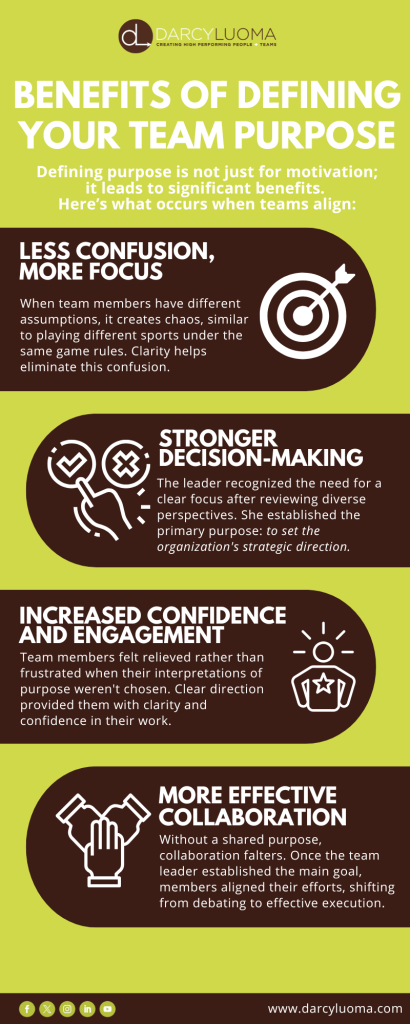
Benefits of Defining Your Team Purpose
When a team’s purpose is crystal clear, it’s like flipping on the stadium lights—suddenly, everyone can see where they’re going. Defining purpose isn’t just a feel-good exercise; it leads to real, tangible benefits. Here’s what happens when teams take the time to align:
1. Less Confusion, More Focus
When team members operate under different assumptions, it’s like playing a game where everyone thinks they know the rules—but they’re all playing a different sport. Clarity eliminates that chaos.
In the case of the team with five different answers, the leader recognized a pattern: the team was busy, engaged, and hardworking—but pulling in different directions. Instead of assuming alignment would happen naturally, she used the discussion as a turning point.
2. Stronger Decision-Making
Once the leader saw the variety of perspectives, she realized the team needed a clear north star. While all the responses had merit, she set the focus: Our primary purpose is to set the strategic direction for the organization.
That simple statement changed everything. It gave the team a decision-making filter. If a topic didn’t tie back to strategy, it was either delegated or discussed in a different forum. Meetings became more focused. Conversations had clearer outcomes. The team wasn’t just talking—they were making progress.
3. Increased Confidence and Engagement
Surprisingly, team members weren’t frustrated that their personal interpretation of purpose wasn’t chosen. Instead, they felt relieved. With clear direction, they didn’t have to wonder if they were working on the “right” things. They had clarity, and with it, confidence.
And confidence breeds engagement. When people understand their role in the bigger picture, they’re more invested. It’s the difference between showing up to “do work” and showing up to “make an impact.”
4. More Effective Collaboration
Without a shared purpose, collaboration can feel like a tug-of-war—lots of effort, but no one moves forward. After this team’s leader defined the primary purpose, team members could finally align their efforts. Instead of debating what they were there to do, they could focus on how to do it well.
At the next meeting, discussions felt different. The purpose wasn’t just a vague idea; it was a guidepost. People spoke with more clarity. Decisions came faster. And most importantly, they were all running toward the same end zone.
Tips to Making Sure Your Team Stays Aligned
It’s one thing to define a team’s purpose. It’s another thing to keep everyone on the same page over time. Distractions pile up, priorities shift, and before you know it, half the team is sprinting toward a different end zone.
Here are some simple ways to keep your team aligned:
- Revisit the Purpose Regularly
Think of your team’s purpose like a mission statement on a gym wall. It’s not enough to have it—you need to look at it often. Make it a standing agenda item in meetings or a quick check-in at quarterly reviews. Ask: “Are we still aiming at the right goal?” - Use Purpose as a Filter for Decisions
When a new project, initiative, or “urgent” request comes up, run it through the purpose filter: Does this help us accomplish our primary purpose? If not, why are we doing it? - Keep Communication Tight
Misalignment often happens when team members interpret the same goal differently. Encourage open dialogue, clarify expectations, and make sure everyone understands not just what they’re doing but why it matters. - Reward Aligned Behavior
Celebrate wins that reflect your team’s purpose. When a player makes the right read in football, they get a pat on the helmet. When someone advances the team’s purpose at work, acknowledge it. Small moments of recognition reinforce alignment. - Call a Timeout When Needed
If things start feeling chaotic, don’t just push through. Hit pause, regroup, and refocus. A quick huddle can prevent a season-long losing streak.
Alignment isn’t a one-and-done event—it’s an ongoing effort. Keep it front and center, and your team will be running the same play instead of tackling each other on the field.

Here’s a core workout for your team
Pause: At the start of your next team meeting, hit the Pause button.
Think: Ask everyone, “What’s the primary purpose of this team?”
Have everyone write their answer on a notecard to avoid groupthink!
Go around the room and have each person share their response.
How similar or different are the responses? Create space for everyone’s perspective.
Act: Discuss how to get aligned so everyone is clear on the team’s primary purpose.
Your team’s primary purpose might never be as straightforward as it is for playoff football teams, but by having the conversations, you can at least agree on the end zone!


