

Courage, Compassion, and Curiosity
At DLCC, we’ve coached hundreds of teams through communication breakdowns that weren’t about the work. They were about the way people were working together. Misalignment, tension, and avoidance don’t just magically go away with more meetings or changing team members. What makes the real difference is how people show up in conversation.
We’ve all been there.
The meeting starts. Cameras off. Silence. One person mumbles a status update. A few half-hearted “mhmms.” No real decisions. No connection. Just another hour that could’ve been an email.
This team isn’t communicating well, but the fix isn’t a better agenda or even having the meeting in person.
The real issue isn’t what they’re talking about. It’s how they’re talking about everything. What’s missing are the three C’s of Balanced Communication: Courage, Compassion, and Curiosity.
We see it all the time. Teams stuck in the storming phase because no one wants to “go there.” Or someone finally does, and leaves a trail of scorched relationships in their wake.
It doesn’t have to be that way. But communication habits don’t change overnight. They change when teams start flexing new muscles, on purpose.
That’s why we focus on the three C’s of Balanced Communication. These are the essential elements that fuel high-performing teams, strong leadership, and a resilient organizational culture. Let’s break them down.
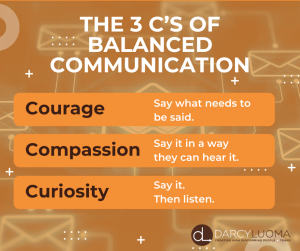
Courage: Say What Needs to Be Said
It’s tempting to stay silent. To avoid conflict. To let something slide because you don’t want to make things “awkward.”
But over time, silence becomes a weight. Resentment builds. Assumptions go unchecked. And issues that could’ve been handled early become full-blown problems.
Courage is the willingness to speak up, even when it’s uncomfortable. It’s naming the thing no one’s saying. It’s giving feedback that might not be easy to hear, but is necessary for growth. It’s asking for what you need instead of stewing quietly in frustration.
Building a culture of courage doesn’t mean everyone blurts out every thought. It means creating space where people feel safe to be honest, because honesty drives clarity, and clarity drives performance.
💡 Try this: Before your next tough conversation, ask yourself: “What’s the truth I’m avoiding?”
Compassion: Say It in a Way They Can Hear It
Compassion is how you deliver your message, especially when you don’t see eye to eye. Without it, disagreement can sound like a personal attack. With it, you remind the other person you’re on the same team, even when your perspectives differ.
We’ve seen team members push their point so hard that they bulldoze others. We’ve also seen people soften their words so much that their point gets lost entirely. Neither builds trust.
Balanced Communication means you can say, “I don’t agree,” in a way that invites dialogue, not defensiveness. It means you’re honest about your view and respectful of theirs.
Tone matters. So does timing. But what matters most is your intent: Are you trying to prove you’re right? Or trying to get to a resolution, together?
💡 Try this: “I see it differently. But let’s keep talking about this so we can find the best path forward.”
Curiosity: Say It, Then Listen
There’s a difference between listening and waiting for our turn to talk. Or trying to win the point. Or checking out because we’ve already decided what the other person really means.
That’s where communication breaks down.
Curiosity is the antidote. It’s what transforms communication from a monologue to a dialogue. It’s the willingness to ask questions, challenge assumptions, and stay open to being wrong.
When teams lead with curiosity, people feel heard. And when people feel heard, they open up, engage more fully, and collaborate more effectively.
💡 Try this: In your next conversation, replace judgment with genuine curiosity. Ask, “Can you help me understand your perspective?”
What Happens When a C Is Missing?
There will always be moments when one of the three C’s of Balanced Communication slips. Maybe someone stays silent when they really need to speak up. Maybe feedback comes out a little too sharp. Maybe curiosity gets replaced with assumptions.
The key isn’t to avoid these moments. It’s to recognize them when they happen and adjust in real time.
Thoughtfully Fit teams aren’t flawless. What sets them apart is their ability to hit pause, notice when a C is missing, and pivot.
- If courage is low, someone steps up and names what’s going unsaid.
- If compassion is lagging, they soften their tone without losing their message.
- If curiosity has left the room, they shift from defending to listening.
This kind of real-time course correction keeps teams moving forward instead of getting stuck. It’s what helps teams navigate tension without derailing trust and what turns everyday conversations into high performance.
That’s the power of practicing Balance, one conversation at a time.
Strengthening the Three C’s in Your Team
You don’t build these communication muscles by accident. You build them by doing the reps.
Whether it’s through a leadership training program or team coaching, we help teams define what courage, compassion, and curiosity look like for them and practice them until they stick.
When teams commit to the three C’s of Balanced Communication, they stop just surviving meetings and start actually solving problems. They speak honestly. Listen fully. And work better, together.
FAQs About the Three C’s of Balanced Communication
How can I help my team recognize when a “C” is missing during a meeting?
Encourage your team to do quick, in-the-moment check-ins. If things feel tense, stalled, or unclear, ask:
- “Do we need to show more courage right now?”
- “How can we have this discussion with more appreciation?”
- “What’s a question we haven’t asked yet?”
This kind of real-time reflection builds self-awareness and helps teams self-correct without needing a formal intervention.
What does “Balanced Communication” look like in action?
Balanced Communication shows up in the small moments, not just in the big conversations. It looks like someone pausing to rephrase a tough message, a leader asking a clarifying question instead of making an assumption, or a teammate checking in when things feel tense. It’s not loud or flashy, but it consistently creates clarity, trust, and momentum across the team.
Can individual team members practice the three C’s if leadership doesn’t?
Absolutely. While leadership sets the tone, anyone can model courage, compassion, and curiosity in their own interactions. When even one person consistently communicates with Balance, it creates a ripple effect. Others notice. Teams often shift from the inside out, especially when those shifts are intentional and consistent.
How do you train for better communication without adding more meetings?
Practicing the three C’s of Balanced Communication doesn’t require extra meetings, but it does require showing up differently in the ones you already have. A team coaching session can build awareness, but the real “training” happens in real time: how you speak up, how you respond, and how you adapt mid-conversation.
What’s the first step for a team that wants to improve communication?
Start with a shared language. Introducing the three C’s of Balanced Communication gives your team a simple, memorable framework. From there, build in reflection: ask after meetings, “Which C showed up? Which one didn’t?” This creates awareness, and awareness is the first rep in any training program.
Looking for more information about team development? Be sure to check out our Leader’s Guide to Building Stronger Teams.


