

A few years ago, I had to have a difficult conversation. I had to confront a vendor who completely missed the mark on a big project. The work was a mess, they hadn’t honored their contract, and I was frustrated. The complication? I really liked the owner. Part of me wanted to just avoid the issue, but I couldn’t afford (literally) to let it slide.
Even sending the email to request a meeting made my stomach turn. Before we talked, I prepped my message triangle, got clear on my requests, practiced my soft start-up, and thought carefully about how I wanted to show up in the conversation. And still, I was nervous.
The conversation lasted about an hour, and it wasn’t easy. The vendor got defensive at times, but I stayed steady. By the end, we found a resolution that worked for both of us, and I made sure to express my appreciation for working through it together.
That’s when the vendor asked, “What’s it like to embrace conflict so well?”
I was floored. I told him the truth: “I don’t embrace it! I have to prepare and psych myself up every single time I have a conversation like this!”
Years later and plenty of conversations later, I still don’t find difficult conversations easy. There’s a reason they’re called difficult! But I’ve learned this: if you wait for difficult conversations to feel easy, you’ll never have them. The good news? You can get better at them.
Six Difficult Conversations That Are Rarely Easy But Can’t Be Avoided
That vendor conversation wasn’t the first time I had to psych myself up, and it won’t be the last. Difficult conversations are part of the job when you’re leading people, running a business, or just trying to work well with others.
Difficult conversations are not just uncomfortable, but they’re unavoidable. And if you dodge them, the problem doesn’t disappear; it usually grows teeth.
There are a handful of conversations that fall into this category. They’re the ones that make your stomach drop the second you realize you have to have them. You might hope the moment will pass, but it doesn’t. Sooner or later, you’ve got to step in.
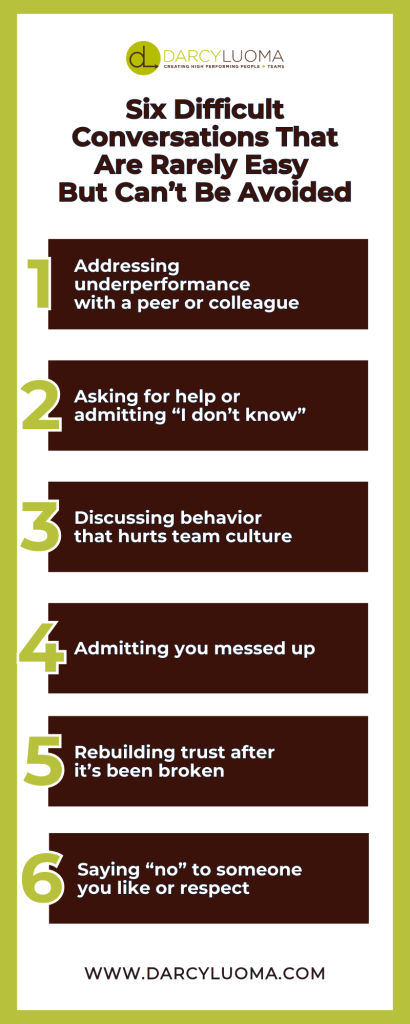
Here are six difficult conversations that are rarely easy but necessary:
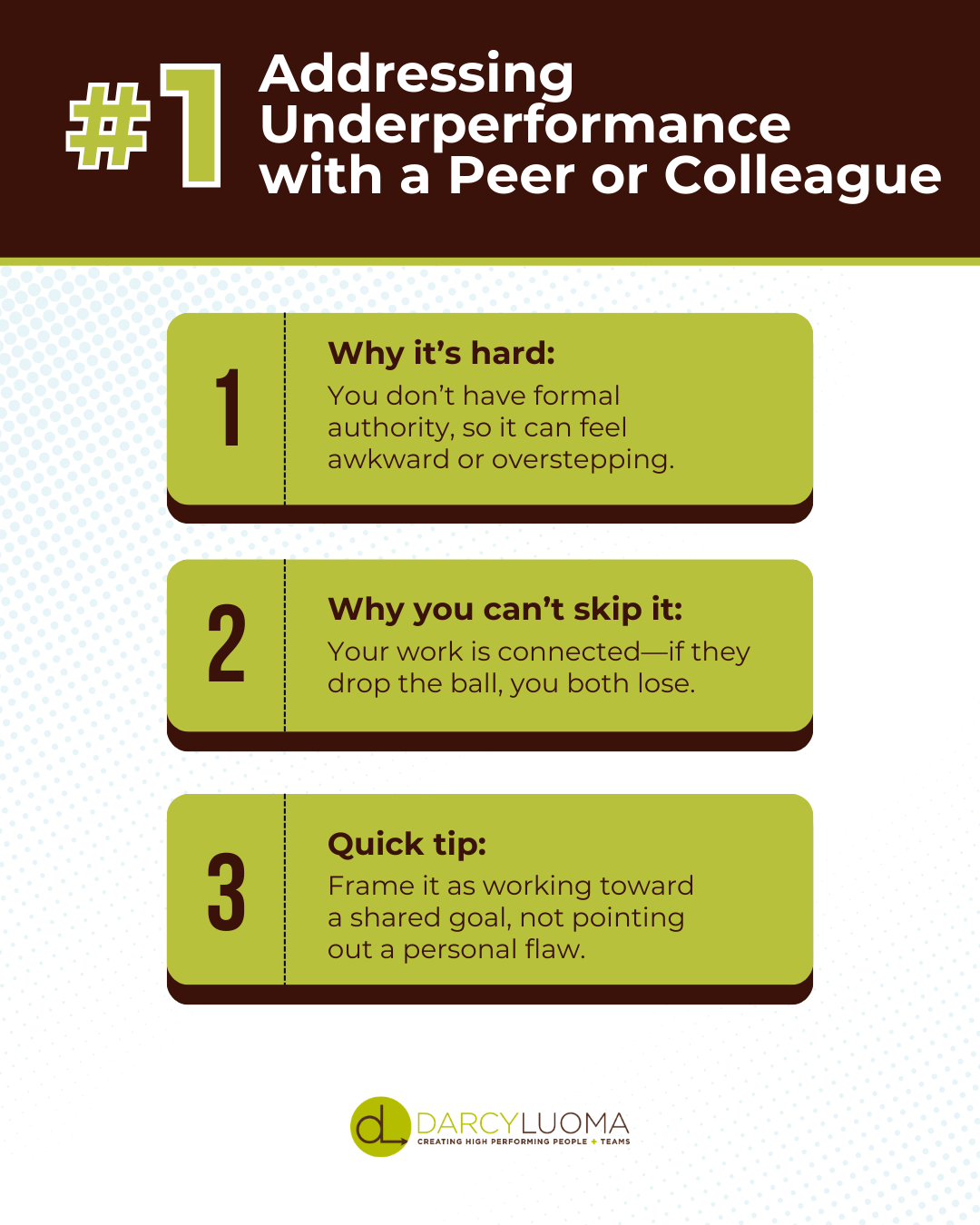
1. Addressing Underperformance with a Peer or Colleague
- Why it’s hard: You don’t have formal authority, so it can feel awkward or overstepping.
- Why you can’t skip it: Your work is connected—if they drop the ball, you both lose.
- Quick tip: Frame it as working toward a shared goal, not pointing out a personal flaw.
More to consider:
This conversation can feel especially tricky if you have a friendly relationship with the person, but staying silent only creates resentment. Try starting with curiosity: “Can we talk about what happened with the project last week? I’d love to figure out how we can support each other moving forward.” That simple shift makes it a partnership, not a confrontation.

2. Asking for Help or Admitting “I don’t know”
- Why it’s hard: Fear of looking weak, unprepared, or unqualified.
- Why you can’t skip it: Struggling in silence slows progress, increases errors, and burns you out.
- Quick tip: Discuss it as a commitment to getting the best outcome, not a personal shortcoming.
More to consider:
It takes strength to acknowledge when you’re out of your depth. Admitting you need help actually builds credibility when you pair it with a desire to learn or improve. Most leaders respect honesty and humility far more than perfection.

3. Discussing Behavior That Hurts Team Culture
- Why it’s hard: It feels personal and can spark defensiveness.
- Why you can’t skip it: One person’s unchecked behavior can tank morale for everyone.
- Quick tip: Focus on the impact, and skip the assumptions about intent.
More to consider:
Culture is shaped by what we tolerate as much as what we celebrate.
A single person who interrupts constantly, ignores input, or gossips can disrupt trust across the team. Addressing it directly but compassionately shows that protecting the team culture is a priority and that everyone is accountable for the environment you create together.
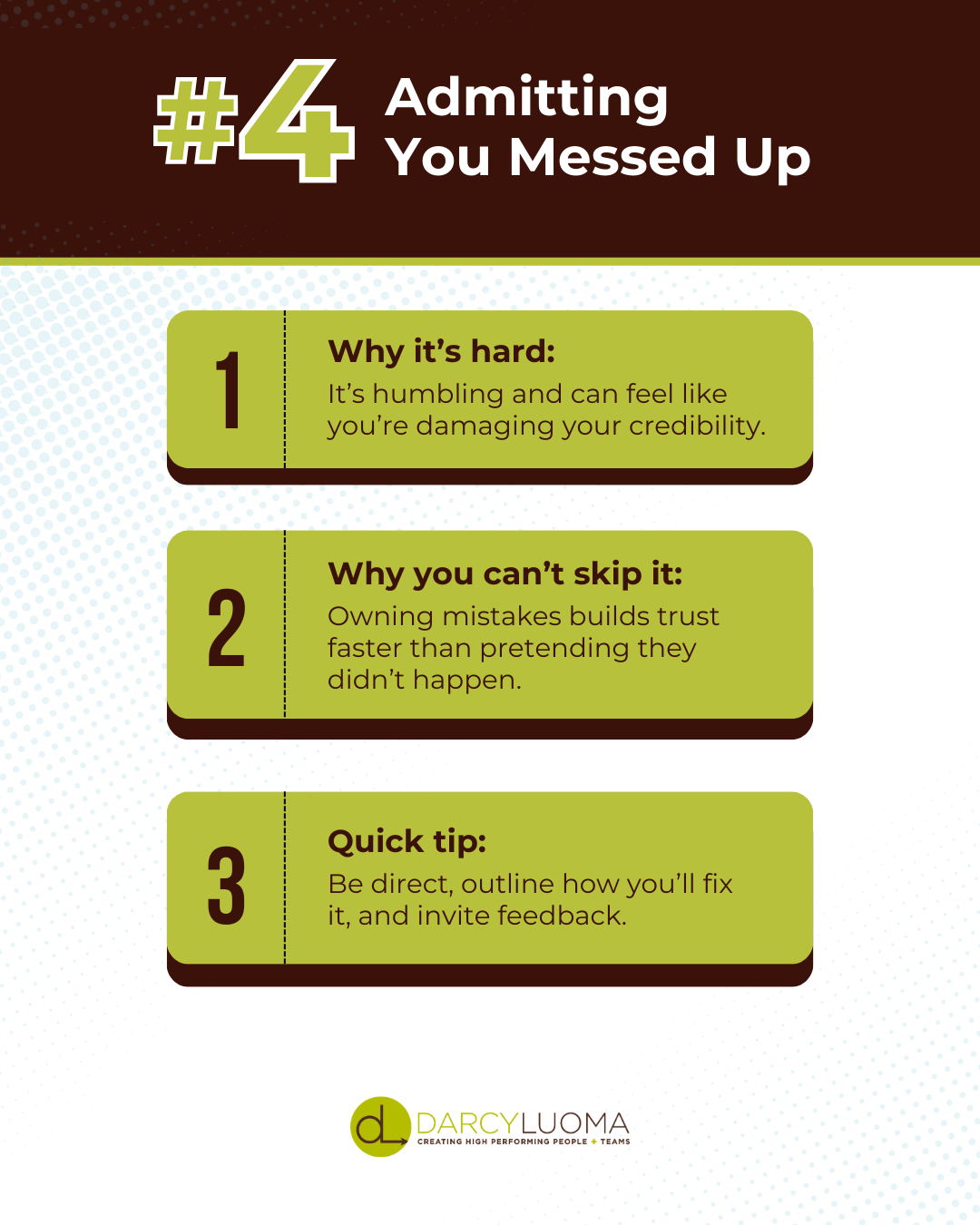
4. Admitting You Messed Up
- Why it’s hard: It’s humbling and can feel like you’re damaging your credibility.
- Why you can’t skip it: Owning mistakes builds trust faster than pretending they didn’t happen.
- Quick tip: Be direct, outline how you’ll fix it, and invite feedback.
More to consider:
Mistakes are inevitable, especially in fast-paced or complex environments. What matters most is how you respond. A simple statement like, “I missed the mark on this and I take responsibility for the impact” can instantly shift tension into a conversation about solutions and moving forward.

5. Rebuilding Trust After It’s Been Broken
- Why it’s hard: Emotions run high, and there may be resentment.
- Why you can’t skip it: Avoidance leaves a crack in the relationship that only widens with time.
- Quick tip: Acknowledge the breach, listen without defensiveness, and focus on the path forward.
More to consider:
Trust doesn’t repair itself on its own; it takes intention.
If you caused the harm or were on the receiving end, re-establishing connection often starts with a willingness to name the tension. And while rebuilding takes time, one honest conversation is usually the first and most critical step.

6. Saying “No” to Someone You Like or Respect
- Why it’s hard: You don’t want to disappoint or damage the relationship.
- Why you can’t skip it: Overcommitting leads to missed deadlines, burnout, and frustration.
- Quick tip: Clear is kind. Consider the trifecta of not me, not now, or not this.
More to consider:
Saying no is a boundary. And boundaries protect your time, energy, and focus so you can deliver your best work. You can decline an ask with grace by expressing appreciation for the opportunity and offering an alternative: “I can’t take this on right now, but I’d be happy to review it next quarter” or “I’m not the best fit for this, but let me suggest someone who might be.”
Lean Into the Discomfort
You don’t have to like conflict to handle it well. You have to be willing to show up, speak clearly, and stay in the conversation long enough to find a path forward. Difficult conversations will always live up to their name but they also create clarity, strengthen relationships, and keep your team and your work moving in the right direction.
Discomfort after a difficult conversation fades. The cost of not speaking up doesn’t.
Looking for more information about leadership development? Be sure to check out: The Ultimate Guide to Leadership Development.


