
The conversation started after someone cracked a joke during a team coaching session. “If I stop typing for two minutes, I know everyone around me is going to be thinking that I’m slacking off.” Others on the team laughed, but it was the kind that comes from shared experience, not a punchline.
This wasn’t at all a team of slackers. These were capable, committed people who genuinely cared about doing good work. They were sharp, responsible, and a little burned out. Their calendars were booked from morning to night. Their notifications never stopped. Clearing out their inboxes felt like its own full-time job.
Under all of that noise was something they didn’t really talk about…this subtle, constant pressure to be visibly busy. Because if you paused, if you took even a moment to breathe or think, you might look like you weren’t pulling your weight.
Eventually, someone said what many others were feeling. “We’re always busy. So why aren’t we feeling productive?” That one question unlocked something they hadn’t said out loud: they were always in motion, but rarely in the zone.
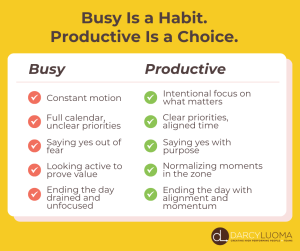
What’s the Difference Between Being Busy and Being Productive?
It’s easy to confuse motion with progress, especially in team environments where speed is celebrated and full calendars are worn like medals. But productivity isn’t simply about staying in constant motion. It’s about being in the zone.
When you’re in the zone, you’re focused, clear, and fully engaged in the work that matters most. You’re not just reacting to what’s flying at you, but you’re working with intention. That’s real productivity.
Busy, on the other hand, often looks like bouncing from one task to the next without stopping to ask if those tasks are actually moving anything forward. It’s checking boxes, sitting in meetings, answering emails, responding to pings, and ending the day exhausted but unsure what you actually accomplished.
The truth is, being in the zone doesn’t always look dramatic or loud. In fact, it can look quieter. It might be someone taking a few minutes to get clear on their top priorities. It might be someone stepping away from the noise to think strategically. It might even be saying no to a request that doesn’t align with the team’s goals.
But in some team cultures, that kind of thoughtful behavior gets misread. Instead of being seen as focused or intentional, it can be viewed as checked out, or worse, lazy. And that’s where things start to go off track, because if the only acceptable way to show value is to look busy, people will perform busy, even when they’re completely out of the zone.
Getting Back To Productivity Is an Intentional Act
Getting in the zone doesn’t just happen by accident. It’s not something we stumble into; it’s something we can build the conditions for. And just as easily, we can learn how to get back there when we fall out.
This doesn’t require an hour-long meditation session or a half-day offsite. Sometimes, it’s as simple as taking two minutes to pause, take a breath, and ask, “What’s most important to focus on right now?” These micro-moments of reflection aren’t about checking out. They’re about checking in so you can realign with priorities, get grounded, and then move forward with purpose instead of panic.
This isn’t the same as taking a break (which is also important). It’s about consciously resetting your focus so you’re not just reacting to everything that shows up in front of you. It’s a practice, and it can be done quickly.
Teams Need to Normalize Resetting to Increase Productivity
If your team treats quick resets as indulgent or optional, people won’t do them. And if no one does them, the norm becomes a constant hustle, even when it’s not effective.
But teams can shift that culture. And it starts with making it okay to step back for a moment of clarity. Resetting might look like a quick team check-in, a leader calling for clarity before diving in, or someone taking two quiet minutes to realign.
When that kind of behavior is acknowledged and supported, it becomes normal. And when it becomes normal, teams get faster at recovering from distraction, misalignment, and overwhelm. They stop spinning their wheels and start moving forward in the same direction.
That’s not a sign of a team slowing down. That’s the mark of a high-performing team that knows how to stay focused when it counts.
Three Questions That Contribute to a Culture of Productivity
There are three questions that can help teams shift from busy to productive—especially when they’re feeling scattered, overwhelmed, or unsure where to focus next. These questions aren’t complicated, but they’re powerful when asked with honesty:
Can we ..
- Acknowledge we all have moments out of the zone? Because pretending we’re always operating at peak performance doesn’t help anyone. Everyone has off moments. Let’s be real about that.
- Agree we don’t want to stay out of the zone? If we’re feeling busy but not productive, we should want to reset. Productivity should be the goal.
- Normalize doing what we need to get back in the zone? Whether that’s a moment of silence, a quick gut-check with a teammate, or jotting down top priorities, let’s make it okay to pause and come back stronger.
When teams have an honest discussion using these questions, they create space for better communication, more thoughtful work, and a shared sense of trust that it’s okay to pause when it makes the work better.
Getting Back in the Zone Shouldn’t Require Permission
That coaching session didn’t end with a quick fix or a dramatic breakthrough. But it did mark a turning point. Once the team named what was happening, that busy seemed to be valued more than productivity, they could start shifting it.
Letting go of “busy” as a badge isn’t easy. Especially for high-achievers who are used to equating effort with value. It takes intention to notice the habits that keep everyone spinning. And it takes courage to replace them with something better.
But that’s exactly what this team did. Over time, they began to challenge the belief that Stillness equals slacking. They created space to get back in the zone, on purpose and without apology. They started recognizing that turning away from the screen for two minutes to reset wasn’t lazy. It was essential.
By setting the expectation that busy wasn’t the goal and that productive meant working with focus, clarity, and alignment, they created a new kind of team norm.
This team’s story might sound familiar because the pressure to look busy is common! But you don’t have to stay caught in that cycle. Productivity isn’t about proving you’re “busy”. The moment you start treating “being in the zone” as a priority instead of a perk, you create space for yourself and your team to do work that actually matters.
Looking for more information about leadership development? Be sure to check out: The Ultimate Guide to Leadership Development.


