

How can you handle difficult employees by simply convincing them they’re the problem, without changing a thing about your own approach?
You can’t. (Wouldn’t it be nice, though?)
Let’s just say it: Some people are a pain to work with.
If you’ve ever dealt with someone who constantly pushes back, drags their feet, or just seems allergic to teamwork, it’s tempting to slap on the label: difficult. But labels don’t solve anything. They just make it easier to roll our eyes and avoid the real issue.
If someone keeps pushing your buttons, there’s a decent chance it’s not just about them.
It might be a sign that something underneath—alignment, trust, communication—is off track with the two of you.
Why “Difficult” Usually Means “Different From Me”
Let’s start with the assumptions. When someone’s behavior feels hard to manage, we often leap to conclusions like:
- They’re not a team player.
- They don’t respect my authority.
- They have a bad attitude.
But here’s what might actually be going on:
1. They’re unclear, not unmotivated.
If expectations are murky, people flail. If you’re frustrated that someone “should know better,” that’s usually your cue to double-check that things were clearly communicated.
2. They care, but don’t feel heard.
Pushback is sometimes passion in disguise. If someone always challenges decisions, maybe it’s not about control. It’s about feeling excluded or undervalued.
3. They’re over it (and too fried to fake it).
Burnout isn’t always obvious. It can look like cynicism, sarcasm, disengagement, or crankiness. You can’t coach someone through chronic exhaustion, but you can spot it and respond with humanity.
Taking a Coach Approach to Handle Difficult Employees
Taking a coaching approach doesn’t mean letting someone vent endlessly or giving them a pep talk about their potential. It means getting curious instead of controlling.
The goal? Understand them better—before trying to make them understand you..
Not every conflict is a personality problem. Sometimes, it’s just a misunderstanding that’s been stewing too long.
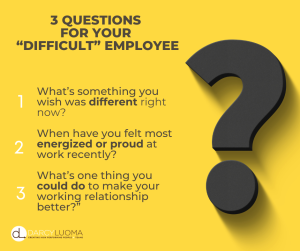
Here are three questions that can help spark a conversation and provide space to find a way forward. (instead of asking questions that imply blame or that quickly get people on the defensive.)
1. “What’s something you wish was different right now?”
This can surface all kinds of gold: misalignment, frustration, even great ideas that have been sitting quietly in someone’s Slack drafts.
2. “When have you felt most energized or proud at work recently?”
Instead of focusing on what’s not working, this gets them talking about what does. It also helps you see what motivates them (and what they might be missing).
3. “What’s one thing I could do to make our working relationship better?”
Yes, this one’s bold. But if you’re brave enough to ask it, it tells your employee: “I’m not just here to fix you. I’m open to adjusting myself, too.”
Leading With Curiosity Isn’t Weak—It’s Strategic
Here’s the deal: You need people to perform. But empathy and accountability aren’t opposites. You need both. Leadership can be less about “fixing” people and more about understanding what’s in their way.
So the next time someone on your team feels like a human speed bump, try to avoid the “difficult” label and get curious instead.
FAQ’s About Handling Difficult People with Coaching
Is it possible to get a difficult employee to realize they’re difficult?
You can try, but don’t hold your breath. Most people don’t respond well to being labeled, especially if they don’t see the label as fair. A better bet? Get curious about what’s underneath the behavior. Insight usually beats confrontation.
How do I stay calm when an employee constantly challenges me?
Start by taking a breath and reminding yourself it’s not personal—even if it feels that way. Then ask: What’s really going on here? Is it pushback or passion? Disrespect or disconnection? Coaching yourself first is half the battle.
What if I’ve tried everything and they’re still difficult?
First: Have you really tried everything, or just the stuff that feels safe? Sometimes what’s left to try is the uncomfortable conversation—the one that starts with, “Can we talk about what’s not working between us?”
Are some people just not coachable?
Sure. Some people aren’t ready or willing to shift, no matter what you do. But often what looks like resistance is just protection. You won’t know which one you’re dealing with until you try asking better questions and actually listening.
Why does it feel like I’m always the one who has to adjust?
Welcome to leadership. Influence tends to follow flexibility—if you’re willing to shift, you might just create the space for someone else to shift too. (And if not, at least you’ll know you did your part.)
Looking for more information about leadership development? Be sure to check out: The Ultimate Guide to Leadership Development.


