


Jill Mueller preparing the turkey
Five years ago, I wrote about bringing compassion to tough family conversations over Thanksgiving because of COVID-19. After a number of difficult conversations, my husband and I spent the holiday at home, just the two of us and our cat. It was the first Thanksgiving of both of our lives where we didn’t have a 20-pound turkey, a dozen side dishes, and a dozen loved ones around the table. For us, turkey thighs, mashed potatoes, gravy, brown-and-serve rolls, and green bean casserole were plenty (along with a half-dozen video calls). All things considered, in the chaos that was 2020, it turned out to be one of my favorite Thanksgivings.
Since then, our family has changed. We lost Grandma. We have more nephews. People have moved to new houses and cities. What hasn’t changed is the annual conversation about when, where, and how we celebrate the holidays. It almost seems to get more complicated and start earlier every year. This year, my brother and my husband’s brother both happened to message the sibling group texts on the same day to open the turkey discussion. It was September 21.
These conversations are rarely easy. They always require all three C’s of balanced communication: courage, compassion, and curiosity. You need courage to speak up when it’d be easier to stay quiet, curiosity to understand where others are coming from, and compassion to make sure your words actually land.
None of them works alone. Courage without compassion feels harsh. Compassion without courage goes nowhere. Curiosity without either gets you stuck in analysis. And while they work best together, compassion is the steady hand that keeps everything from tipping over.
Compassionate Leadership Defined
Let’s be honest. Family holiday planning is basically project management with more carbs and fewer boundaries. The same mix of personalities, emotions, and timing challenges also appears at work. And in both places, compassion is what keeps things from falling apart.
That’s compassionate leadership. It’s not soft. It’s steady. It’s the combination of clarity and care that builds trust.
Too often, leaders confuse compassion with being “nice.” They tiptoe around tough conversations, avoid conflict, or sugarcoat feedback so much that it loses its value. But niceness doesn’t build strong teams. Honesty does. And honesty without compassion just feels like criticism.
I’ve coached leaders who delayed hard feedback for months because they didn’t want to “hurt feelings.” By the time they finally said something, frustration had built up on both sides. When we unpacked it, the leader admitted they thought compassion meant avoiding discomfort. But genuine compassion isn’t about keeping people comfortable, it’s about helping them grow.
Another leader I worked with took a different approach. They started a tough performance conversation with, “This might be hard to hear, but I’m sharing it because I believe in your potential.” They were firm but human. The employee left that meeting not defeated, but motivated.
That’s what compassionate leadership looks like. It’s not about sparing feelings. It’s about caring enough to speak the truth in a way that strengthens, not shatters.
The Value of Compassionate Leadership
The payoff of compassionate leadership isn’t theoretical. You can feel it in the room.
When leaders consistently show compassion, the energy on the team is different. People speak up more freely. Meetings become less about self-protection and more about solving problems. That’s when teams can hit their stride.
Research backs this up. Studies from Harvard Business Review and Gallup show that leaders who pair accountability with empathy see higher engagement, lower turnover, and stronger performance. Why? Because compassion creates psychological safety. And psychological safety unlocks performance.
Compassion doesn’t mean lowering the bar but rather creating an environment where people can successfully reach it.
I once coached a leader who was brilliant but intimidating. Her team described her as “a genius… who made them feel stupid.” She didn’t mean to. She just valued excellence so much that she forgot how to connect. When she began showing more compassion (asking questions before giving direction, thanking people for trying, acknowledging effort), the entire team dynamic changed. Projects got smoother. People spoke up earlier. And results improved.
Compassionate leadership isn’t sentimental. It’s strategic. It builds trust, which is the ultimate competitive advantage.
Compassionate Leadership in Action
Compassion is what makes courage digestible. It’s the gravy that helps the hard truth go down easier.
Compassionate leadership isn’t just about what you say but how you say it, how it lands, and what happens next.
Here’s what it might look like in action:
- A manager delivers hard feedback and circles back later to ask how it was received. That simple follow-up signals care and builds resilience.
- A leader acknowledges upfront that a conversation will be tough and explains why it’s still essential. That sets the tone for honesty, not defensiveness.
- A colleague pauses mid-meeting to ask, “How is this landing for you?” instead of plowing ahead. That small question can change the entire energy in the room.
I’ve seen leaders transform their communication simply by learning to notice what’s not being said: the crossed arms, the silence, the quick “I’m fine” that clearly isn’t fine. Compassionate leadership means paying attention.
And when you check how your message lands, you show your team that you care about the impact, not just the message. The most effective leaders use compassion to ensure their message connects and moves everyone forward.
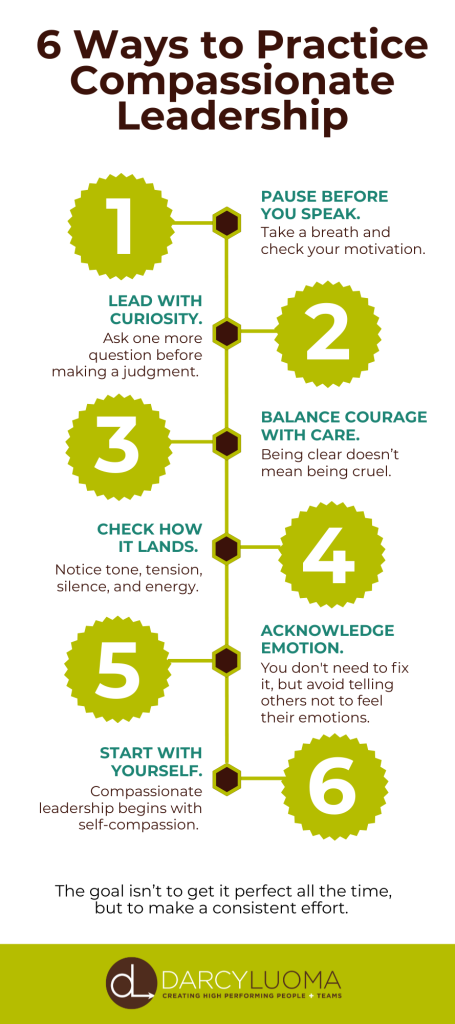
6 Ways to Practice Compassionate Leadership
Compassion is a muscle. The more you use it, the stronger it gets. Here are six ways to start practicing:
- Pause before you speak. Take a breath and check your motivation. Are you trying to prove you’re right or find a resolution for everyone?
- Lead with curiosity. Ask one more question before making a judgment. Curiosity slows the rush to conclusions and fosters a deeper understanding.
- Balance courage with care. Being clear doesn’t mean being cruel. You can hold high expectations and hold people accountable with empathy.
- Check how it lands. Notice tone, tension, silence, and energy. If your message didn’t land the way you hoped, try again. Adjust, don’t retreat.
- Acknowledge emotion. You don’t have to fix it. But you also don’t want to tell people not to feel what they are feeling. Just naming it, “I can sense the frustration here,” can diffuse defensiveness and invite dialogue.
- Start with yourself. Compassionate leadership begins with self-compassion. If you can’t extend grace to yourself after a hard day, it’s tough to offer it to others.
The goal isn’t to get it perfect all the time, but to make a consistent effort.
Compassionate Leadership: Use Your Powers for Good
Compassionate leadership is powerful. But it’s not a power play. Real compassion starts with integrity.
There’s no shortcut or “five-step hack” to make people trust you. A lot of leadership advice out there reads like a list of tricks: say this, do that, mirror this body language, nod at this cadence. But compassion? It can’t be a tactic. It’s not something you turn on when it’s convenient and off when you’re frustrated.
Compassionate leadership is effective only when it’s genuine and stems from a real desire to understand, rather than manipulate. If you’re faking empathy just to get compliance, it’ll backfire fast. Teams can smell insincerity before you finish your sentence.
Develop compassion because you care about people, not because you want to look like a “good leader.”
And here’s the good news: when people know you genuinely care, they’ll forgive the occasional misstep. You can stumble through a clumsy phrase or a poorly timed comment, and they’ll still give you grace. Because at the end of the day, they know your intent is to help, not to win.
Same Skills, Different Table
Family isn’t perfect, but most of the time, the effort to gather says enough. If we’re spending time figuring out who’s bringing what, driving where, and eating when, it’s because we care about being together, even when it’s complicated. Compassion is baked into that.
At work, it takes more intention. We don’t always assume care the way we do with family. But when leaders lead with real, genuine compassion, it creates the same foundation of trust. It reminds people they matter, that they’re part of something worth showing up for.
We may not always get it right, at the dinner table or in the conference room, but compassion is what keeps us trying. It’s what turns tension into teamwork, disagreement into dialogue, and effort into results. And just like a good Thanksgiving meal, compassion is what brings us all together.

Jill’s nephew and green bean casserole sous chef
Frequently Asked Questions About Compassionate Leadership
What is compassionate leadership?
Compassionate leadership is the practice of leading with both clarity and care. It’s about striking a balance between courage and empathy—being direct and holding people accountable while also showing genuine concern for their well-being. Compassionate leaders foster trust, cultivate psychological safety, and empower their teams to perform at their best.
Why is compassion important in leadership?
Compassion fosters stronger workplace relationships and enhances team communication. When leaders demonstrate compassion, people feel valued and heard, which in turn increases engagement, collaboration, and performance. It turns tense conversations into productive dialogue and helps organizations build healthier cultures.
How can I practice compassionate leadership at work?
Start small. Pause before reacting, lead with curiosity, and check how your words land. Acknowledge emotions without judgment and balance courage with care. Over time, these habits foster trust and enhance communication within your team.
Is compassionate leadership the same as being “nice”?
Not at all. Being “nice” often means avoiding hard truths or uncomfortable feedback. Compassionate leadership is about honesty delivered with empathy. It’s firm, fair, and focused on growth. True compassion helps people improve, not just feel good.
Can compassion really drive business results?
Yes. Research from Harvard Business Review and Gallup shows that leaders who pair accountability with empathy see higher employee engagement, lower turnover, and better performance outcomes. Compassion isn’t just good for people—it’s good for business.
What’s the difference between empathetic and compassionate leadership?
Empathy is the ability to feel what someone else feels. Compassion goes a step further. It’s understanding that feeling and choosing to act in a way that supports growth and resolution. Compassionate leadership combines empathy with accountability and action.
How can leaders develop more compassion?
Like any skill, compassion grows with practice. Reflect after hard conversations, ask for feedback, and model vulnerability. Leadership development programs, executive coaching, and professional coaching can also help leaders build self-awareness and strengthen their compassion muscle.
Looking for more information about leadership development? Be sure to check out: The Ultimate Guide to Leadership Development.


