

Change management is rarely as smooth as the slide deck makes it look.
A few weeks ago, I was coaching an HR leader who was managing yet another change at her company.
“Maria’s” company had gone through a series of shifts over the past year: new leadership, reorganized departments, and evolving priorities. The latest change? A restructuring of teams and reporting lines that she wasn’t consulted on but was now expected to help implement. It didn’t come as a surprise, but it was one more layer of uncertainty for a team already stretched thin from a year of nonstop change.
She came into our coaching session looking drained. Not panicked. Just… worn out.
She said, “I know change is constant, but this feels like whiplash. People are frustrated. I’m frustrated. I’m supposed to be the one helping others navigate it, but I don’t even know where I stand in all of it half the time.”
Maria was naming the feeling that so many leaders experience but rarely say out loud: the pressure to hold it all together, to absorb the pushback, and to keep people steady when you don’t feel steady yourself.
Yes, change Is constant. No, that doesn’t make change management easier.
Maybe you’re always onboarding new employees. Or you’ve been handed a new system to implement. Or your organization is “pivoting” (again) and you’re expected to get your team excited about it, even though you’re still trying to figure out how you feel about it. Or maybe you’re just trying to keep track of the changes coming from the federal government.
It’s a lot.
And the hardest part isn’t the logistics. It’s the humans.
You’re managing personalities, fears, resistance, and maybe your own concerns and anxiety. Most leaders want to do the right thing, but in the swirl of change, instinct can lead you into traps that make things harder.
Here are three of the most common leadership missteps during change and what actually works instead.
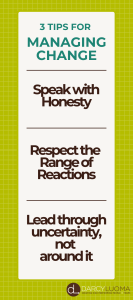
1. Instead of thinking: “I need to stay positive to keep morale up.”
-
Do this: Speak with honesty, not spin.
When change hits, the instinct is often to slap on a smile and say, “This is going to be great!”
But here’s the truth: pretending everything is fine when it’s clearly not kills trust.
Your team can sense when something’s off. If you’re overly polished or overly positive, they start questioning everything—including your leadership.
Instead, name what’s real. Something like, “This is a big shift. I know it may feel uncomfortable. I’m still figuring some of it out, too.”
That kind of authenticity builds credibility—and connection.
2. Instead of thinking: “Everyone just needs to get on board.”
-
Do this: Respect the range of reactions.
Every team has a mix of styles when it comes to change.
You’ve got:
- Leapers who want to run toward the new thing yesterday.
- Tradition Holders who need time, structure, and reassurance.
- Bridge Builders who want to see proof and ask questions before they commit.
Know who your people are. Use your Leapers to build momentum. Give your Tradition Holders more runway. Validate the Bridge Builders while still moving forward. The people who don’t love the change aren’t your adversaries. Don’t make yourself theirs.
Resistance doesn’t mean sabotage. It usually means fear, fatigue, or frustration. Instead of pushing back harder, get curious. Ask what’s behind the hesitation. When people feel heard, they’re more likely to engage, even if they don’t love the change.
3. Instead of thinking: “I should have all the answers.”
-
Do this: Lead through uncertainty, not around it.
Your job isn’t to be a walking FAQ—it’s to create clarity, direction, and trust, even when you’re in the dark. Pretending to have all the answers might feel like strong leadership, but it usually reads as inauthentic, or worse, tone-deaf.
Your team doesn’t need you to have it all figured out. They need to know you’re in it with them.
Perfection creates distance. Presence builds trust.
When change is unfolding fast and information is still evolving, your people are listening for consistency more than certainty. It might feel vulnerable. But that kind of transparency is what creates psychological safety, a key ingredient in high-performing teams.
Bottom Line: People don’t resist change. They resist poorly managed change.
Change is hard. Resistance is normal. What matters most is how you show up as a leader when things feel uncertain.
Whether you’re a seasoned executive or a new manager, your ability to lead change with empathy, clarity, and consistency will define your team’s success and your own.
For Maria, the frustration didn’t magically lift. But something shifted when she stopped trying to hold it all together and just showed up as herself—clear, steady, and honest.
That’s what most teams need during change. Not a hero. Not a hype machine. Just a leader who’s willing to be real when things are hard, and present when things are unclear.
There’s no perfect way to lead through change. But showing up thoughtfully? That’s a pretty solid start.
FAQ’s on Leading During Change Management
What if I disagree with the change I’m being asked to implement?
Being a leader sometimes means getting behind a decision you wouldn’t have made yourself. If the decision didn’t go your way, don’t undercut it. You can acknowledge that there were multiple paths forward without undermining the one that’s been chosen. Be transparent about what’s in your team’s control, what’s not, and how you’ll support them through the transition.
What’s my role if I’m not a decision-maker, but people look to me for answers?
You don’t have to be “in charge” to be a steady presence. Share what you know. Admit what you don’t. And most importantly, create space for others to process. Leadership is less about title—and more about how you show up.
How do I keep my own frustration in check while leading others?
Give yourself permission to feel it. Vent to a peer, coach, or journal—not your team. And reconnect to your values: Why does your leadership matter here? Grounding yourself makes it easier to show up with intention (not just reaction).
Looking for more information about leadership development? Be sure to check out: The Ultimate Guide to Leadership Development.


