

How to Reset a Leadership Partnership That’s Lost Traction
If you read our last post on the five ways leadership duos lose traction, you might be sitting with some new awareness right now. Maybe even some relief, because naming what’s been happening is the first step toward doing something about it.
So let’s talk about what to do next.
When we work with leadership duos who are feeling stuck, frustrated, or just quietly off, the instinct is almost always the same: “Skip to the plan. Let’s figure out what we’re going to do differently. Tell us how to fix it.”
I understand that instinct. Leaders are doers. You want to take action. But here’s what I’ve seen over and over again: when you skip to the plan before you’ve done the real work, the plan doesn’t stick. Because you’re building it on a foundation that hasn’t been examined.
So here are four steps to reset. Not all of them are easy, but all of them are essential to get back on track.
Step 1: Acknowledge That There’s a Disconnect
This sounds simple. It isn’t.
For most leaders, saying I feel like we’re disconnected or something feels off between us is genuinely hard. The path of least resistance is to hope it gets better on its own. I’ll tell you what I’ve seen happen when people take that path: it doesn’t get better. The disconnect grows and what could have been a simpler conversation becomes a much bigger problem.
So the first step is simply to say it out loud. Not to assign blame, not to diagnose the problem, just to name it. I’m feeling disconnected. I’m feeling like we’re not as aligned as we used to be. I want to talk about it.
That’s it. That’s step one. And it takes more courage than it sounds like it should.
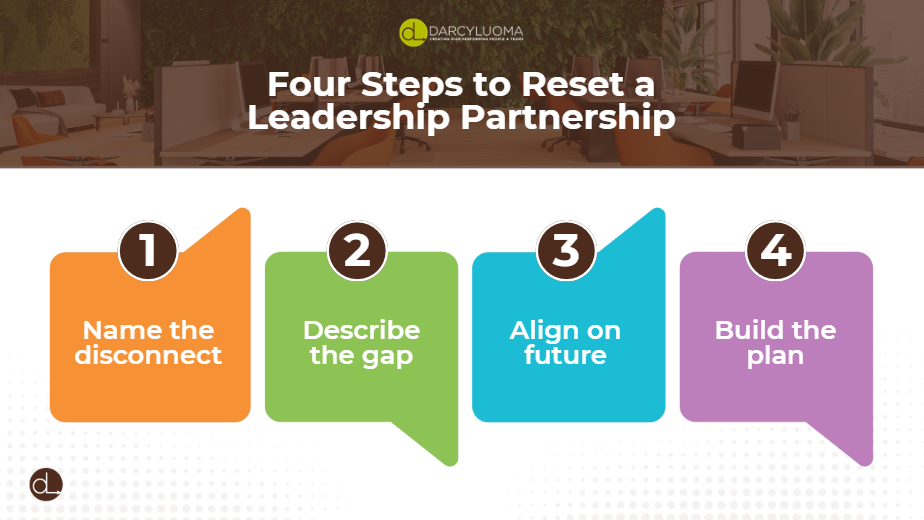
Step 2: Describe the Gap
Once you’ve named the disconnect, the next step is to get specific about where you see the gap and to ask your partner where they see it.
This is where people often make a mistake: they share their perspective on the gap and stop there. But that’s only 50% of the conversation. The other 50% is getting genuinely curious about how your partner is experiencing it. Because here’s what I can almost guarantee: you will see the gap differently. You have different strengths, different personalities, different vantage points. Of course, you see it differently.
And that difference? That’s not a problem. That’s rich. That’s where the real insight lives. When you can say here’s where I see the disconnect AND what’s your experience? and then actually listen to the answer, you start to understand not just what’s happening but why.
A question we use a lot in alignment coaching: On a scale of one to ten, how aligned do you feel right now? And I always have people answer at the same time (write the number down first) so one person’s answer doesn’t influence the other. If one person says two and the other says eight, that gap is information. That’s exactly where the conversation needs to go.
Step 3: Get Aligned on the Future You Want
This step is about looking forward, not just individually, but together.
It’s one thing to say I’m going to show up better or I’m going to communicate more. That’s individual. What we’re talking about here is: what do we want our partnership to look like going forward? What does a strong version of us look like?
Maybe you’ve been so heads-down that you haven’t even had a real check-in as partners in months. Maybe you’ve drifted into parallel operation and you need to rebuild some shared ownership. Whatever it is, this is the step where you get aligned on the future before you start making a plan to get there.
The key for this part of the conversation is to not worry about the “how.” That part comes later. The importance of this step is getting clear on “what” you are working towards, even if it feels difficult. The more honest everyone can be at this step, the more likely your plan is to stick in the long term.
Step 4: Decide on a Plan Together
Here’s the good news: if you’ve done the first three steps well, step four is the easy one.
By the time you’ve named the disconnect, described the gap from both perspectives, and gotten aligned on what you want your partnership to look like, the plan almost writes itself. Because now you both understand what you’re solving for. You’ve done the hard work. The plan isn’t a guess anymore; it’s a shared commitment.
What we see most often is people skipping steps one, two, and three and jumping straight to the plan. And then they get frustrated when it doesn’t stick. It doesn’t stick because you built it without the foundation. The plan is only as strong as the conversation that preceded it.
A Note on How You Start the Conversation
One more thing before you go have this conversation with your leadership partner: how you start matters enormously.
The research shows that 96% of the time, how a conversation starts is how it will end. If it starts with criticism and blame (you always do this, you never do that), it’s likely to end in defensiveness and shutdown. If it starts softly (I’m feeling frustrated and I’d like to talk about it), it has a better chance.
When to Bring In Outside Support
Sometimes the most courageous thing a leadership duo can do is say: We need help with this conversation.
That’s what alignment coaching is for. Not to diagnose you or prescribe solutions, but to hold space for both of you to name what’s really happening, to describe the gap honestly, and to build a plan together with someone facilitating who has no stake in the outcome.
Alignment coaching works if you want it to work. If you come in with a sincere desire to figure it out, whether that means getting more aligned to move forward together or getting aligned on how to dissolve the partnership with integrity, it can be genuinely transformative.
If any of this has resonated with you today, we’d love to connect. You can schedule a free Fit & Focus call with our team today. You don’t have to have it all figured out before you reach out. That’s what the meeting is for.


