

Corporate communication can be surprisingly hard. Sometimes you’re not sure what needs to be said. Other times, you know exactly what you want to say, but getting the tone right, figuring out how much detail to include, or deciding which channel to use? That’s where things get messy. And when communication goes sideways, it doesn’t just create confusion, it chips away at trust, slows down progress, and leaves teams guessing.
Done well, though, corporate communication does more than inform. It connects people, reinforces culture, and gives everyone the clarity they need to move forward.
What Corporate Communication Looks Like (and Why It Matters So Much)
At its core, corporate communication is how an organization shares information—internally with employees and externally with clients, partners, and the public. It shows up in big ways (company-wide announcements, executive messages, press releases) and in everyday interactions (project updates, Slack threads, meeting recaps).
Internally, strong communication builds alignment and keeps teams working toward the same goals. Externally, it shapes how others see your organization and what they believe about who you are. In both cases, communication has the power to build momentum or create friction.
And it’s not just about what’s said—it’s about how clearly, consistently, and intentionally it’s delivered. If your communication is confusing, vague, or full of assumptions, people will fill in the blanks themselves. If it’s thoughtful and clear, they’ll feel confident, informed, and connected to what’s happening.
Here are seven ways to make sure your corporate communication does exactly that.
7 Tips for Clearer, Smarter Corporate Communication
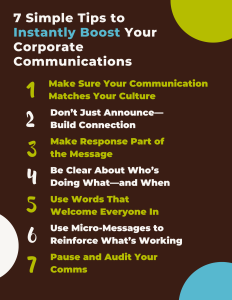
- Make Sure Your Communication Matches Your Culture
Every message you send reflects your company’s values—whether you mean for it to or not. If you say you value transparency, but your updates are full of vague language or missing context, people notice. Your communication should feel like your culture.
- Do this: Use clear, human language that reflects your company’s voice and values.
- Not that: Don’t send copy-paste messages that sound like they came from a legal template.
- Don’t Just Announce. Build Connection
It’s tempting to treat communication as a checklist item: draft the email, send the update, move on. But real communication creates connection. People don’t just want information. They want to feel included in what’s happening.
- Do this: Use storytelling, vulnerability, or a personal tone to bring your message to life.
- Not that: Don’t deliver top-down messages with no context or emotion.
- Make Response Part of the Message
Good communication is a two-way street. But too often, messages are delivered like a closed-door announcement—no space for questions, input, or conversation. Even a small invitation to respond can create better alignment and fewer misunderstandings.
- Do this: Invite feedback, questions, or conversation—directly and explicitly.
- Not that: Don’t assume silence means agreement.
- Be Clear About Who’s Doing What—and When
Ambiguity kills momentum. If you’re outlining decisions, deadlines, or next steps, be specific. Say who’s responsible. Say when it’s due. Say what “done” looks like. Clarity avoids the dreaded follow-up email asking, “Wait, was I supposed to do that?”
- Do this: Use names, dates, and action verbs when outlining next steps.
- Not that: Don’t use “we” or “soon” when names and dates are available.
- Use Words That Welcome Everyone In
Jargon. Acronyms. Insider language. It’s easy to default to them, especially when you’re in a rush. But if you want your message to truly land, make it accessible. Inclusive language is clear, respectful, and conscious of different perspectives, roles, and experiences.
- Do this: Read your message through the eyes of someone new to your team or company.
- Not that: Don’t assume everyone knows what “EOD,” “QBR,” or “KPI” actually mean.
- Use Micro-Messages to Reinforce What’s Working
Not every message needs to be a bold, branded campaign. In fact, the smaller, more casual ones often have more impact. A quick Slack message saying “great job,” a thank-you at the end of an email, or a line in a presentation that celebrates progress? That’s what people remember—and repeat.
- Do this: Find natural, bite-sized ways to highlight wins and reinforce positive behavior.
- Not that: Don’t save recognition for performance reviews or milestone moments.
- Pause and Audit Your Comms
Most teams rarely take the time to ask, “How are we communicating?” Messages pile up, styles drift, and suddenly your internal communication feels messy or misaligned. Look at tone, frequency, clarity, and whether your messages are actually being read.
- Do this: Schedule quarterly reviews of your internal comms channels and materials.
- Not that: Don’t wait until something blows up to realize your messaging isn’t landing.
The Bottom Line on Corporate Communication
Communication is one of the most powerful tools you have to shape your culture, build alignment, and lead with clarity. It’s not just about checking the box or pushing out updates. It’s about how your organization feels in everyday moments.
You don’t need to overhaul everything to make a difference. A few intentional shifts can raise the quality of your corporate communications and the confidence of your team.
Do that consistently, and corporate communication becomes more than a function. It becomes a force.
Corporate Communication FAQ’s
What’s the difference between corporate communication and internal communication?
Corporate communication is the broader umbrella. It includes both internal communication (what you share within your organization) and external communication (what you share with clients, customers, partners, and the public). Internal communication is a subset—but a critical one.
How do I know if my communication is actually effective?
Look for signs of clarity, not just completion. Are people asking fewer “wait, what’s happening?” questions? Are updates being read and acted on without constant follow-ups? If your communication results in smoother collaboration, stronger alignment, or fewer misunderstandings—you’re on the right track.
Is it possible to over-communicate?
There’s research that shows overcommunicating is better than undercommunicating, but ideally, you work to find the right balance. If messages are long, unclear, or sent through too many channels, people tune out. Focus on clarity, brevity, and choosing the right format for the message.
What if my team is remote or hybrid?
All the more reason to be intentional. In distributed teams, communication is the culture. Be extra clear. Use multiple formats. Repeat important messages. And make space for feedback—because misalignment can sneak in without hallway chats.
Looking for more information about leadership development? Be sure to check out: The Ultimate Guide to Leadership Development.


